Let's define artificial intelligence (AI) in general before delving into its role in education. Machines may now perform jobs that have historically required human cognition thanks to artificial intelligence. Artificial intelligence (AI) can understand and mimic conversational language, solve problems, make decisions, and learn from unstructured data.
Understanding AI in Education
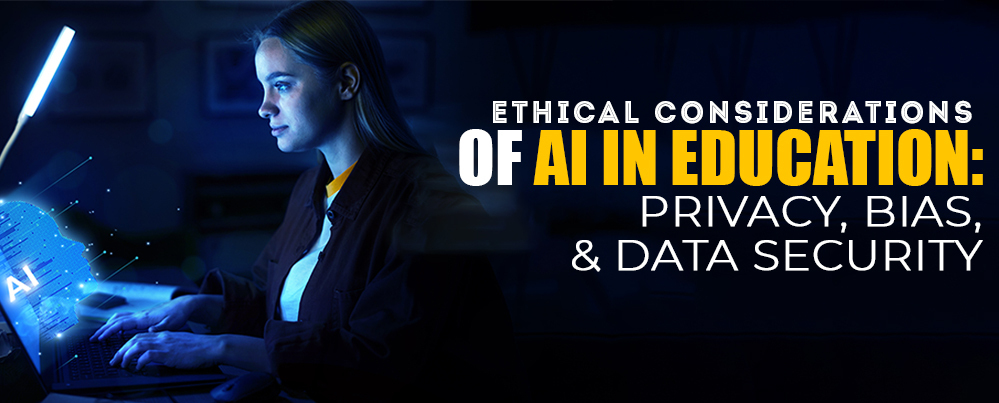
As AI technologies advance, we will continue to learn more about how they will fit into the educational landscape. We also don't yet fully understand how AI will impact ethical, equitable, and data security concerns.
AI-powered educational games, adaptive learning platforms, data security in education, and chatbots in higher education enhance play-based learning. AI systems automate tasks, free up educators' time for student contact, and provide support through admissions queries, course information, and brainstorming ideas. Intelligent tutoring systems simulate one-on-one tutoring and exam experiences, focusing on specific subjects.
Importance of Ethical Considerations
It's critical to address the ethical concerns surrounding AI in education for several reasons.
To preserve human rights and dignity: Students' and teachers' basic human rights and dignity may be compromised by the ethical concerns surrounding AI in education.
To guarantee effectiveness and quality: The efficacy and quality of educational processes and results may be impacted by the ethical concerns surrounding AI in education.
To promote equity and inclusion: The inclusiveness and equity of educational opportunities and rewards may be impacted by the ethical concerns surrounding AI in education.