
logo
HomeBlogs

Software as a Service (SaaS) Market: Global Growth, Applications, Deployment Models & Emerging Trends

Software as a Service (SaaS) Market: Global Growth, Applications, Deployment Models & Emerging Trends

Discover the global SaaS market outlook, including market size, growth projections, major applications, cloud deployment models, industry adoption, and emerging trends.

Software as a Service (SaaS) Market: Global Growth, Applications, Deployment Models & Emerging Trends

As technology has transformed industries, Software as a Service (SaaS) has become an important part of global growth. How? Instead of purchasing software licenses, installing applications, or managing their infrastructure individually, organizations are now opting for SaaS products. It offers subscription or user-based payment models and can be used through a cloud-based platform.

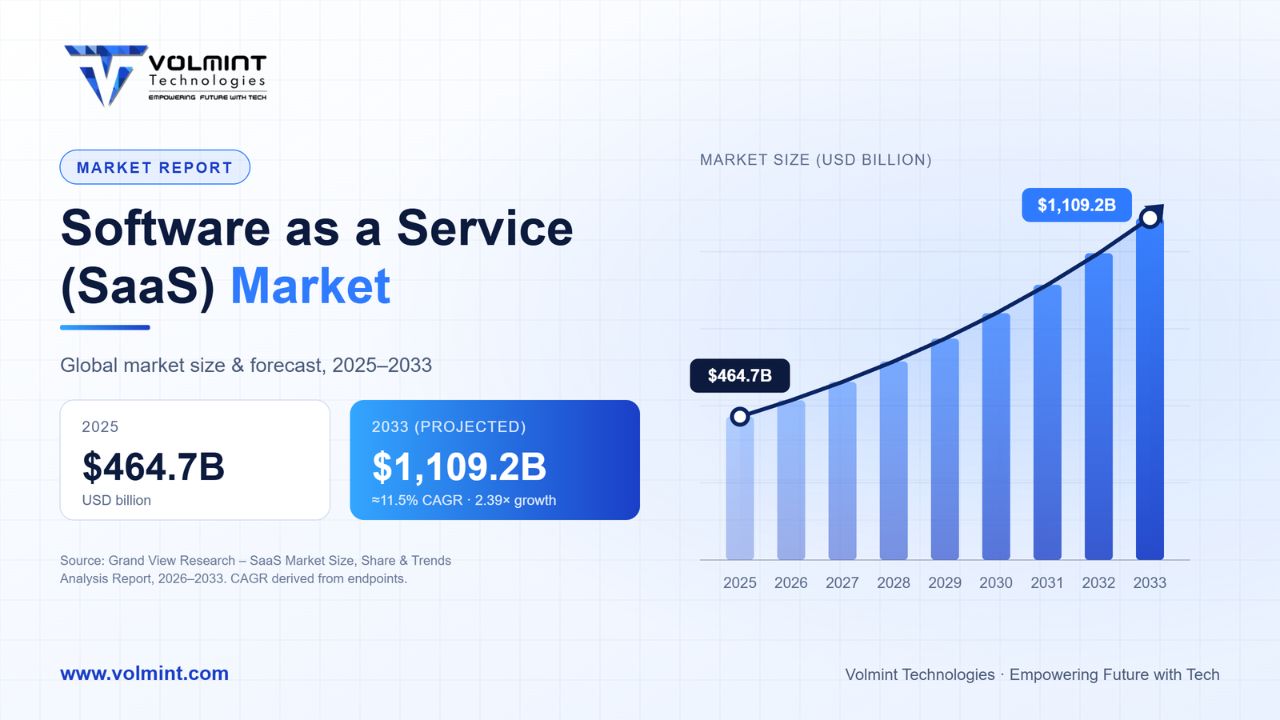
The rise of SaaS has changed how businesses interact and manage customer interactions, financial operations, communication, human resources, and other essential business activities. The scale of this shift is reflected in the latest market analysis by Grant View Research. As per the SaaS Market Report (2026-2033), the global SaaS market was valued at USD 464.7 billion in 2025. However, it is projected to reach USD 1,109.2 billion in 2033. This change represents a compound annual growth rate (CAGR) of 11.1% between 2025 and 2033.

The global market expansion of SaaS is not driven by a single type of software or a particular industry, but by growing demand across business applications, cloud deployment, and enterprise sizes. Meanwhile, concerns around data protection, system integration, regulatory compliance, and service reliability continue to influence.

Through this report, the Grand View Research market analysis helps to understand the structure of the SaaS industry and growth parameters.

How Large is the Global SaaS Market?

As businesses are actively choosing automation, organizations are relying on cloud infrastructure to perform everyday tasks and business operations. Based on the previous records and continued expansion of the SaaS industry, the report published by Grand View Research estimates that the market, at USD 464.7 billion in 2025, may exceed 1.1 trillion by 2033, forecasting a CAGR of 11.1% between 2025-2033.

Market Indicator

Reported Volume

Global Market Size in 2025

USD 464.7 Billion

Estimated Market Size in 2033

USD 1.109.2 Billion

Market Estimate for 2026

USD 530.0 Billion

Forecast CAGR (2025-2033)

11.1%

Largest Regional Market

North America

North America’s Revenue Share in 2025

44.1%


Which SaaS Applications Account for the Largest Market Demand?

From managing customer interactions to finances, human resources, and internal coordination, SaaS applications are designed to cover all business areas. Some of the major segments are:

Customer Relationship Management (CRM)

CRM holds the largest segment in 2025, generating 22.0% of global SaaS market revenue. Cloud-based CRM helps to track and manage customer information, sales activities, marketing campaigns, and offers a centralized system to coordinate effectively.  

Enterprise Resource Planning (ERP)

ERP helps to bring multiple business operations, such as finance, accounting, inventory, supply chain, procurement, manufacturing, and more under, one single platform.

Human Capital Management (HCM)

HCM applications are also categorized among demanding segments, helping organizations to manage workforce-related operations, such as recruitment, employee records, attendance, payroll, and other related activities.

Business Intelligence & Analytics

As data and analytics play an important role in a company's growth, the business intelligence and analytics SaaS solutions help to convert complex data into understandable analytics, empowering managers to make data-driven decisions.

Content, Collaboration, and Communication

Under this segment, SaaS solutions that provide documentation, video conferencing, and communication tools come. This is the fastest-growing segment, projecting a CAGR of more than 17.9% from 2025-2033.


What are the Different SaaS Models and How Do They Work?

How a SaaS application is hosted can be determined through a deployment model. Grand View Research has categorized deployment segments into 3 models: Public Cloud SaaS, Private Cloud SaaS, and Hybrid Cloud SaaS.

  • Public Cloud SaaS- The public cloud SaaS applications are managed by 3rd party cloud service providers. It allows organizations to access the solution using a URL over the internet without investing in dedicated application infrastructure.
  • Private Cloud SaaS – When an organization uses a dedicated cloud deployment, it is known as Private Cloud SaaS infrastructure. Based on the 2025-2033 Grand View Research Market Report, it is the largest deployment segment, accounting for 44.6% of SaaS market revenue.
  • Hybrid Cloud SaaS- Hybrid Cloud SaaS infrastructure combines both private and public cloud ecosystems. It allows organizations to use private cloud for sensitive information and public cloud resources for other application requirements.

How Does SaaS Adoption Differ Between Large Enterprises and SMEs?

Both large enterprises and SMEs are actively adopting SaaS to streamline business operations. However, the size of an organization influences how it evaluates, purchases, and implements software.

Large Enterprises

Small and Medium Enterprises (SMEs)

Large or Big organizations often operate from different locations and business units, having multiple departments to manage. Thus, their software requirements may include complex workflow, integrations, data management, security controls, and a larger user population. As the reports, the large enterprises accounted for 57.9% of Global SaaS market revenue in 2025.   

On the other hand, SMEs accounted for the fastest CAGR during the report forecast period. For smaller businesses, maintaining traditional software infrastructure may include substantial initial investment, technical resources, and ongoing maintenance.

SaaS adoption is no longer limited to the size of an organization, its flexibility and relevancy making it ideal for small and medium enterprises as well.


Which Industries Are Driving SaaS Adoption?

Whether it is about the education sector, financial sector, or healthcare, every industry has their own work culture. SaaS adoption varies based on the business preferences. Grand View Research examines several industry segments, such as:

  1. Healthcare – Healthcare industry using SaaS applications for administrative management, patient information, consultation scheduling, record management, and operation coordination.
  2. Banking, Financial Services and Insurance (BFSI) – Accounted for 24.7% of Global SaaS Market revenue; BFSI is the largest industry segment adopting SaaS to overcome business challenges.
  3. Education (EdTech) – The education industry is adopting cloud-based solutions, such as LMS, exam proctoring systems, admission management systems, and other platforms to support online and hybrid learning modes.
  4. Retail and Consumer Goods – Retail businesses use SaaS to manage customer communication, marketing campaigns, inventory, sales reports, and e-commerce activities.
  5. Manufacturing – Manufacturing industries are relying on SaaS to manage supply chain coordination, resource planning, inventory management, and business analytics.

What is Driving SaaS Market Growth & What Challenges Could Limit Adoption?

There is no doubt that the SaaS market is growing with each passing day as businesses are now adopting automation. However, it has its own challenges that limit the adoption of SaaS applications.

Growth Indicators of SaaS

Constraints and Risk

Cost Efficiencies and Scalability

Data Security and Privacy

Remote and Hybrid Work Culture

Regulatory Compliance

Artificial Intelligence and Automation

Internet Dependency and Service Availability

Multi-device accessibility

Integration with Existing Systems

Easy accessibility and smooth operations

Long-Term Cost and Vendor Dependency

Industry-Specific Applications

AI Involvement, Changing Prices


Which Region Leads the Global SaaS Market?

While estimating the growth of the SaaS market, going through regional adoption is important to understand how it affects different countries and their business acumen.

As per the report shared by Grand View Research, North America accounted for 44.1% of Global SaaS Market Revenue in 2025, making it the largest regional market. The statistics are calculated based on SaaS providers, developed infrastructure, and widespread cloud infrastructure.

The report also highlights Europe, Asia-Pacific, Latin America, the Middle East, and Africa. Its country-level scope includes the United States, Canada, Mexico, Germany, United Kingdom, France, China, India, South Korea, Australia, Brazil, Saudi Arabia, and UAE.

Conclusion

Software as a Service (SaaS) has developed a broader software delivery model that helps businesses operate seamlessly and securely through cloud-based infrastructure. It empowers businesses across industries of all sizes. As per the Grand View Research, the Global SaaS Market will reach USD 1.109.2 billion in 2033, which was recorded as USD 464.7 billion in 2025. As businesses are adopting automation and continuous modernization, the demand for cloud-based solutions increases. Therefore, SaaS is likely to remain an important part of the global software ecosystem.

More Blogs

Contact Volmint Technologies

Let's Connect for Technological Brilliance

Reach Out to Volmint Technologies Today and Unleash the Power of Customized Solutions Tailored to Elevate Your Business.

Contact Us
Footer Background Circle
SaaS Market Size, Growth, Trends & Forecast 2026–2033