logo
HomeBlogs

Introduction To AI Vs. Live Proctoring: Advantages and Limitations

Introduction To AI Vs. Live Proctoring: Advantages and Limitations

Explore the key differences between AI proctoring and live online proctoring, including monitoring methods, response times, costs, scalability, advantages, and limitations. Learn when to choose automated monitoring, live human supervision, or a hybrid proctoring system for secure and fair online exams.

Introduction To AI Vs. Live Proctoring: Advantages and Limitations

Live Online Proctoring and AI-Powered Proctoring are the two major ways to monitor students during the online examination. Both methods help institutions protect exam integrity and prevent exam malpractice to conduct a fair and smooth remote assessment. Although both play important roles during online exams, they differ in how they monitor candidates, identify potential violations, and review activities.

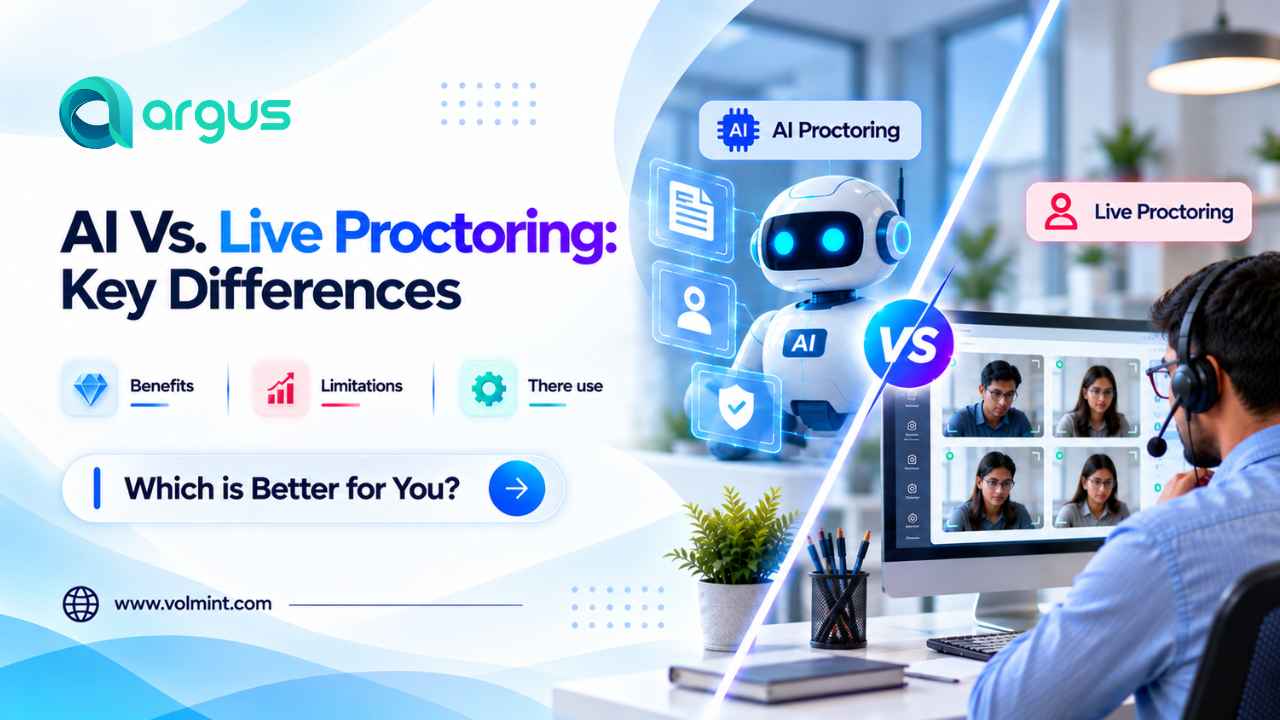
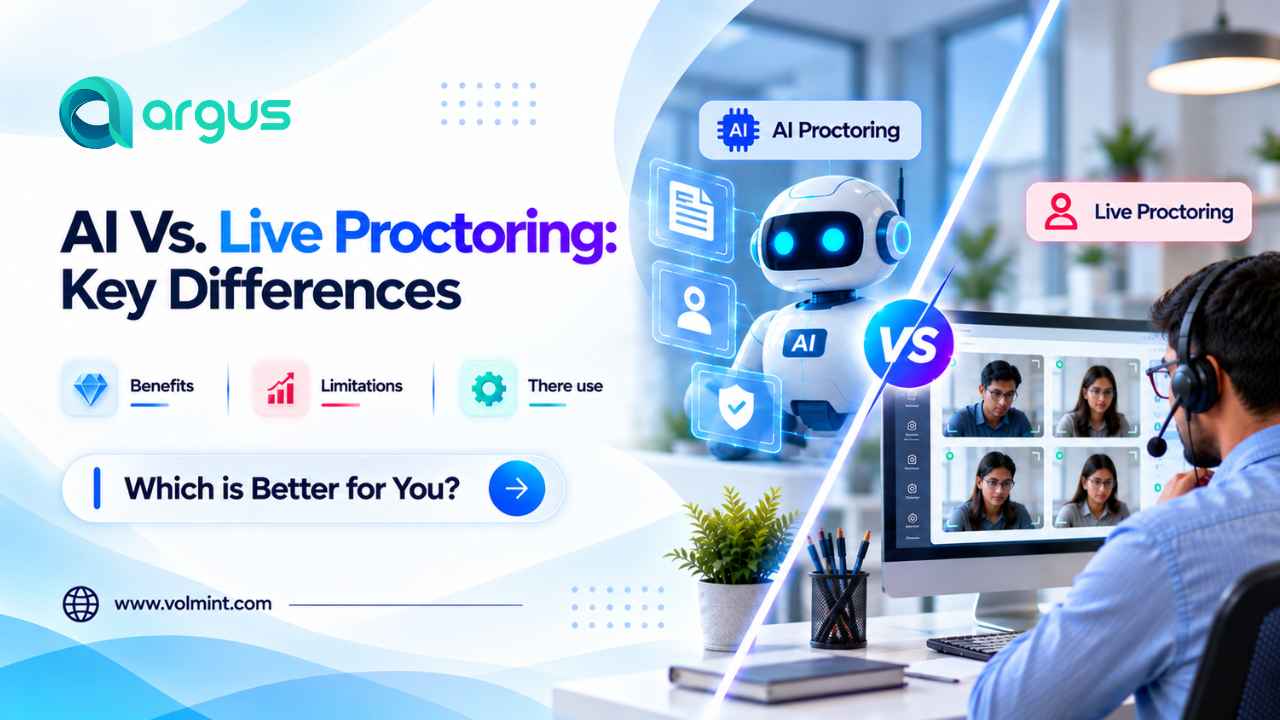
What is the main difference between AI and Live Proctoring? AI exam monitoring uses artificial intelligence and similar technologies to detect suspicious activities and automate the system. Live proctoring involves a human invigilator to monitor candidates in real time. As technology increases, some exam proctoring systems combine both approaches, offering an AI + Human hybrid proctoring ecosystem.

In this blog, we will introduce the AI Proctoring System and Live Proctoring, along with their key differences, advantages, and limitations.
What is AI Online Proctoring?

AI Online proctoring uses artificial intelligence and related technologies to monitor selected aspects of a remote exam and identify suspicious activities that require immediate attention to maintain exam integrity. Based on the chosen platform, AI-enabled online proctoring software may include face detection, identity verification, audio signals, and browser activities.

When the system identifies any violation or breach that matches the predefined parameters set by the institutions or system configuration, it may generate alerts and save the footage for further review.

AI Online Proctoring can be useful for institutions and certification providers that conduct exams at scale because automated monitoring can process events without the direct involvement of a human invigilator, ensuring efficiency and productivity.

Is AI Alert accurate? Not always. The accuracy of AI proctoring systems depends on their configuration, detection capabilities, and the context in which alerts are generated. Technical limitations and variations in human behavior can affect detection accuracy, making it important to understand AI proctoring accuracy metrics when evaluating system performance. 

What is Live Proctoring?

Live proctoring involves a trained human invigilator who supervises candidates during remote exam monitoring using supportive signals, such as a webcam and microphone. The supervisor monitors candidates in real time, asks for screen sharing when required, and uses other legitimate tools to maintain fairness.

The proctor monitors the complete exam cycle from candidate verification to suspicious behavior, or any technical issues facing during the exam. He/She can communicate directly with the test-taker and instruct them to overcome challenges, ensuring no rules are broken.

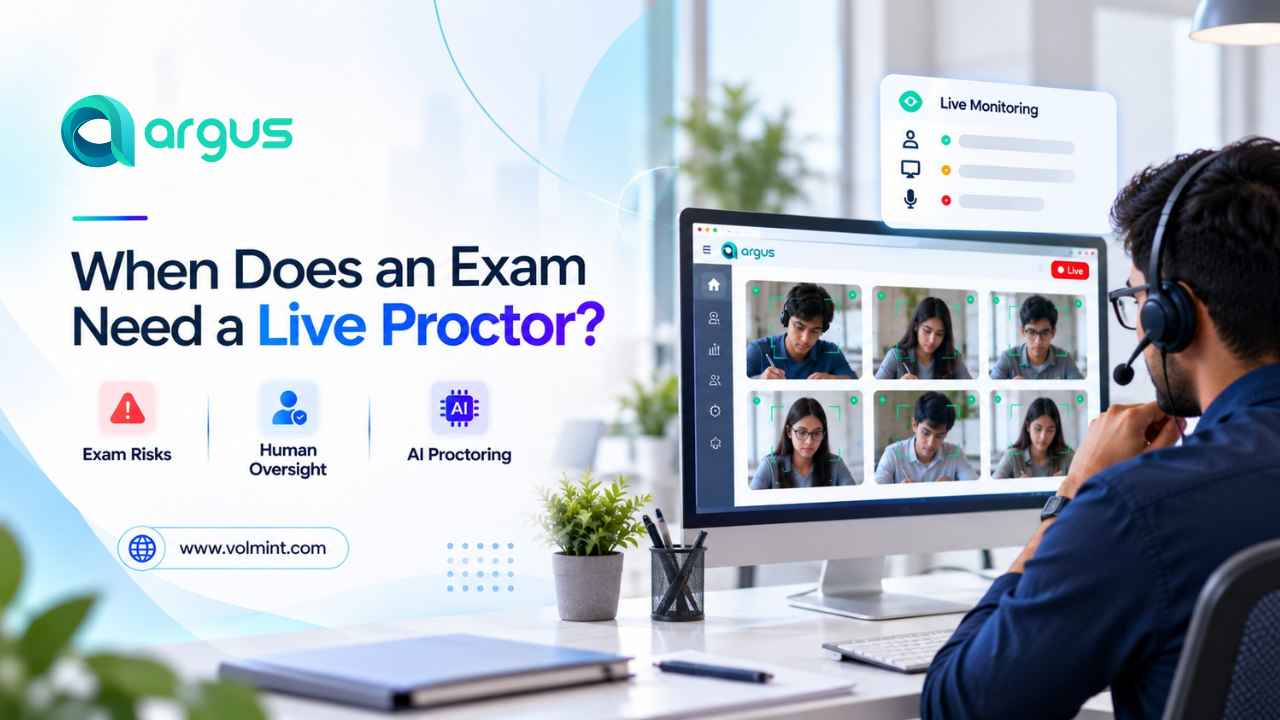
Live proctoring is very common for high-stakes certification exams, professional licensing exams, college tests, and corporate testing. It helps to reduce false positives in AI Proctoring, making assessment engaging for students and proctors.

AI Proctoring Vs. Live Online Proctoring: Key Differences at a Glance

Both AI Proctoring and Live Proctoring are the two most common methods used for online exam monitoring. However, they are different in terms of supervision, response time, scalability, cost structure, and how the alerts are evaluated.

Comparison Factors

AI Proctoring

Live Online Proctoring

Monitor

Monitoring through selected signals (Webcam or Microphone) and activities.

A human invigilator monitoring students in real time through a webcam.

Response Time

Based on the system configuration, the alert may be generated during the exam or after the exam.

The proctor can respond to it immediately as it happens.

Human Judgement

Human involvement is required for ambiguous cases.

Immediate human intervention and review to maintain decorum.  

Scalability

AI Proctoring software can monitor thousands of students at once.

Requires staffing, and only a limited number of students can be monitored on one screen.

Cost Structure

Lower staffing requirements make it affordable.

Requires more staff and faculty for supervision

False Alerts

The False Positives in AI proctoring can be high, based on the software capability.  

Human observers can interpret context but may also make mistakes


AI Proctoring or Live Proctoring: which one to choose? Choosing between them depends on the institution's unique exam requirements. However, selecting AI+Human Hybrid Exam Monitoring Software can be the best choice for 100% accuracy and reliability.

What are the advantages and limitations of AI Proctoring?

AI Exam Monitoring can make the exam more manageable, especially when institutions need to conduct exams across different locations and time slots, and candidates are using different devices.

Advantages of AI Proctoring

Limitations of AI Proctoring

Reduces dependency on human invigilator/observer

May generate false positives and false negative alerts.

Supports monitoring regardless of different locations, number of students, device capabilities, and exam time slots.  

Not able to understand candidate intent and distinguish between natural behavior and forged movements.

Continuous monitoring without human intervention, generating time-stamped alerts and reporting issues for review.

Depends on system capabilities, suitable devices, connectivity, and monitoring conditions.

Highly scalable, flexible exam scheduling, depending on the platform.

Requires appropriate privacy safeguards and a clear process for reviewing alerts.


Please note that AI Proctoring is not a replacement for human invigilation; its value depends on detection capabilities, exam requirements, and oversight process.

What are the advantages and limitations of Live Proctoring?

 In Live Proctoring, direct supervision by a human invigilator is involved, which can be highly valuable when a candidate needs immediate assistance or when an exam requires contextual judgement.

Advantages of Live Proctoring

Limitations of Live Proctoring

Allows direct engagement with real-time communication.

Requires trained invigilators and advanced scheduling to avoid any issues during the exam.

Supports immediate guidance when required

Requires staffing as per the number of students to maintain the ratio.

Helps proctors/reviewer to understand the event clearly before deciding.

Proctor attention and consistency may vary.

Can accommodate certain situations that require individual attention, subject to institutional policies.

Availability can be limited during peak examination periods or across different time zones.


What to know about AI Flags and Human proctoring: check out the link and clear your doubts.

Which is Better: AI Proctoring or Live Online Proctoring?

Both proctoring systems have their own advantages and limitations. Thus, choosing the one that aligns with the unique exam requirements of every student can be difficult, as they both use different supervision parameters and evaluation processes.

Choosing one is not just about preferring the mode; it requires a deep understanding of the system's capabilities, budget, and features.

  • Choose AI Proctoring when you need to monitor a large number of students and want to automate alerts to support exam review.
  • Choose Live Online Proctoring when real-time supervision, direct communication, and immediate guidance are your preferences.

For best results, choose a hybrid system that combines AI with human supervision, minimizes unnecessary alerts, and allows human intervention, making the process smooth and reliable.

Conclusion

AI and live online proctoring serve the same broad purpose but approach exam supervision differently. AI proctoring supports automated monitoring at scale, while live proctoring provides real-time human observation and intervention.

For institutions selecting online exam software, the key is to match the proctoring method to the assessment's requirements. A well-designed approach should balance exam integrity, operational efficiency, student privacy, and fair review of potential violations.


Frequently Asked Questions

More Blogs

Contact Volmint Technologies

Let's Connect for Technological Brilliance

Reach Out to Volmint Technologies Today and Unleash the Power of Customized Solutions Tailored to Elevate Your Business.

Contact Us
Footer Background Circle
AI Proctoring vs Live Proctoring: Differences, Pros & Cons